
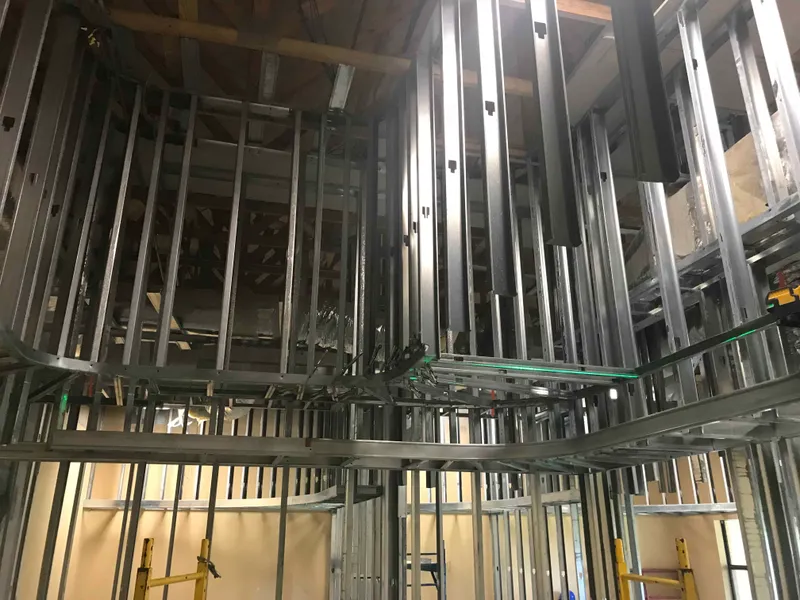
A backing register connects those items to the wall package. It does not design support, assign a load capacity or authorize field substitutions. Its purpose is to make the required information and responsible reviewer visible while changes are still accessible.
Start with the item, not a generic strip of backing
Identify the exact fixture, its mounting system and the manufacturer's information. Record the intended location and reference point for dimensions. “Backing at television” is not enough if the display size, bracket, height or position changes later.
Ask the appropriate designer or qualified party to confirm loads and support details. A list of possible backing products is not a selection method. ClarkDietrich publishes several backing systems and their documentation, illustrating why product-specific details belong in the coordination record. ClarkDietrich backing systems.
Copy this backing register
| ID | Room/wall | Mounted item | Mounting information | Design/detail reference | Responsible approval | Pre-close record |
|---|---|---|---|---|---|---|
| B-01 | Example: conference east wall | Display and bracket, identify | Dimensions/load data pending | To be issued | Named reviewer | Photo/reference pending |
| B-02 | Example: workroom north wall | Wall cabinets | Supplier drawing reference | To be confirmed | Named reviewer | Pending |
| Your item | ___ | ___ | ___ | ___ | ___ | ___ |
The example entries intentionally remain unresolved. A register should reveal missing information rather than conceal it beneath an assumed standard detail.
Coordinate the wall assembly
Check the proposed support against the specified partition system and other services. Fire-resistance, acoustic requirements, framing configuration and concealed equipment may affect the available solution. Do not insert a generic material into a rated or otherwise specified assembly without the appropriate review.
Record conflicts with pipes, wiring, controls and adjacent openings. Resolve them through the project's design and coordination process rather than moving the support to a convenient location that no longer matches the fixture.
Establish a pre-close release
Before boarding conceals the work, confirm the current fixture schedule, issued detail, installed position and any required review. Photograph each location with its register ID and a useful fixed reference. Images are supporting records—not proof of design adequacy or a substitute for required inspections.
If the fixture has not been selected, identify that as an open decision with an owner and deadline. “We will figure it out later” should not be recorded as completed backing.
Manage late changes explicitly
In an illustrative office project, a display becomes larger after the original wall coordination. The team should revisit the bracket, load information, position and support detail before installation. The existence of concealed backing does not automatically mean it suits the new item.
Record the revision, affected wall, approval, cost or schedule impact and updated closeout reference. Give the final register to the party mounting the item; a photograph retained only by the framing crew may never reach the installer who needs it.
For Southern Drywall Services' commercial scope, share the fixture schedule and coordination requirements early. The benefit is a documented interface between trades, not a blanket promise that any finished wall can support anything added later.