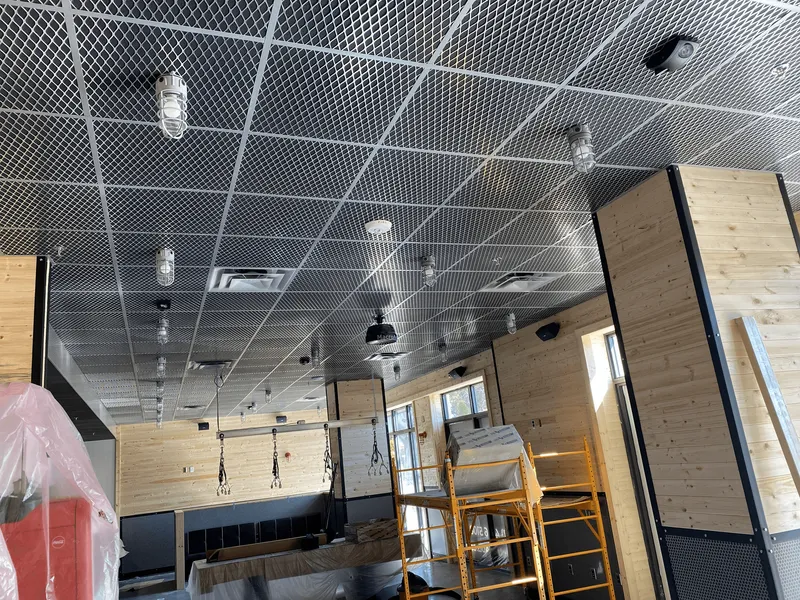
A stained or sagging ceiling panel is evidence, not a diagnosis. The source may be a roof or plumbing leak, condensation, high humidity, cleaning damage, equipment discharge, a missing panel, or another above-ceiling condition. Replacing the visible tile before the source is resolved can erase the timeline and lead to another damaged panel.
Keep people away from sagging, water-loaded, falling, electrically affected, contaminated, or structurally unsafe areas. Follow the facility's emergency, environmental, infection-control, and qualified-trade procedures before ordinary ceiling work.
Open a condition record before moving anything
- Room, grid coordinates, tile count, date first observed, and who reported it.
- Wide photos showing fixtures, diffusers, sprinklers, walls, and the full affected ceiling area.
- Close photos of stain boundaries, sag direction, tile edges, grid condition, and debris.
- Recent rain, plumbing, HVAC, roof, fire-sprinkler, cleaning, construction, or shutdown events.
- Temporary controls, restricted area, removed panels, and every person who accessed the ceiling.
Resolve the source and obtain a release
Identify the party responsible for the roof, plumbing, mechanical, fire-protection, envelope, remediation, or other source. Record the repair date, drying or cleaning work, testing, and written release for ceiling restoration. A dry-looking tile does not prove that insulation, deck, piping, ductwork, wiring, or concealed surfaces are ready.
EPA moisture guidance says porous ceiling tile may need to be discarded when moldy and emphasizes correcting the water problem. Do not paint or coat a stained tile as a substitute for resolving its source and checking the product manufacturer's maintenance limits.
Identify the exact ceiling panel
- When conditions are safe and facility procedures allow, record markings from the back of an unaffected panel.
- Measure face size, thickness, edge profile, reveal, directionality, color, texture, and grid interface.
- Find the manufacturer and item number in current data sheets or the manufacturer's replacement tool.
- Record discontinued status and the proposed current match or substitution.
- Obtain a physical sample before ordering a large replacement area.
Armstrong's replacement guidance uses the tile item number or photos to help identify a match and cautions that comparison products are not necessarily identical substitutes. Appearance alone cannot establish acoustic, fire, humidity, cleanability, seismic, or other performance.
Preserve every required performance characteristic
| Characteristic | Existing record | Replacement approval |
|---|---|---|
| Acoustics | NRC, CAC, privacy, room criteria, or assembly information | Designer or owner acceptance of selected panel |
| Fire | Fire-resistance design, flame/smoke data, fire-guard grid, or other requirement | Approved assembly and code documentation |
| Environment | Humidity, sag, mold/mildew, washability, soil, impact, or clean-room needs | Product data suitable for actual room conditions |
| Access and safety | Hold-down clips, seismic details, security, access, fixtures, and sprinklers | Project-specific installation details |
| Appearance | Color, texture, edge, age, lighting, and direction | Sample and replacement boundary approval |
Inspect the suspension system and interfaces
- Main beams, cross tees, perimeter molding, hanger wires, clips, fasteners, and visible corrosion or deformation.
- Fixture, diffuser, sprinkler, speaker, detector, access-panel, and partition-head interfaces.
- Missing, cut, or unsupported panels and components not matching the documented system.
- Above-ceiling debris, insulation, equipment, piping, or cabling bearing on panels or grid.
- Who evaluates and corrects work outside the ceiling contractor's scope.
Choose a replacement boundary under normal lighting
New tile can differ from aged tile because of color shift, dust, cleaning, UV exposure, or product changes. Compare spot replacement, one grid bay, one room, or a larger continuous area. Record whether appearance matching or exact technical performance takes priority when the original product is unavailable.
Close out the condition record
- Source correction and release documents.
- Existing and replacement manufacturer, item number, performance data, lot, and quantity.
- Grid or above-ceiling corrections completed by each responsible trade.
- Installed photos from the original stations and an updated ceiling plan.
- Attic stock location, cleaning limits, warranty, and recurrence contact.
Helpful public and manufacturer references
- EPA mold cleanup basics — moisture correction and porous ceiling-tile context.
- Armstrong commercial ceiling performance FAQs — replacement and cleaning guidance.
- Armstrong replacement ceiling finder — panel identification by item number or photos.
- Armstrong humidity and sag-resistant ceilings — matching panel performance to room conditions.